
What is hyperspectral imaging (HSI)?
Seeing Beyond the Visible
An introduction to hyperspectral imaging (HSI)
Here, we introduce the fundamental limitation of human vision.
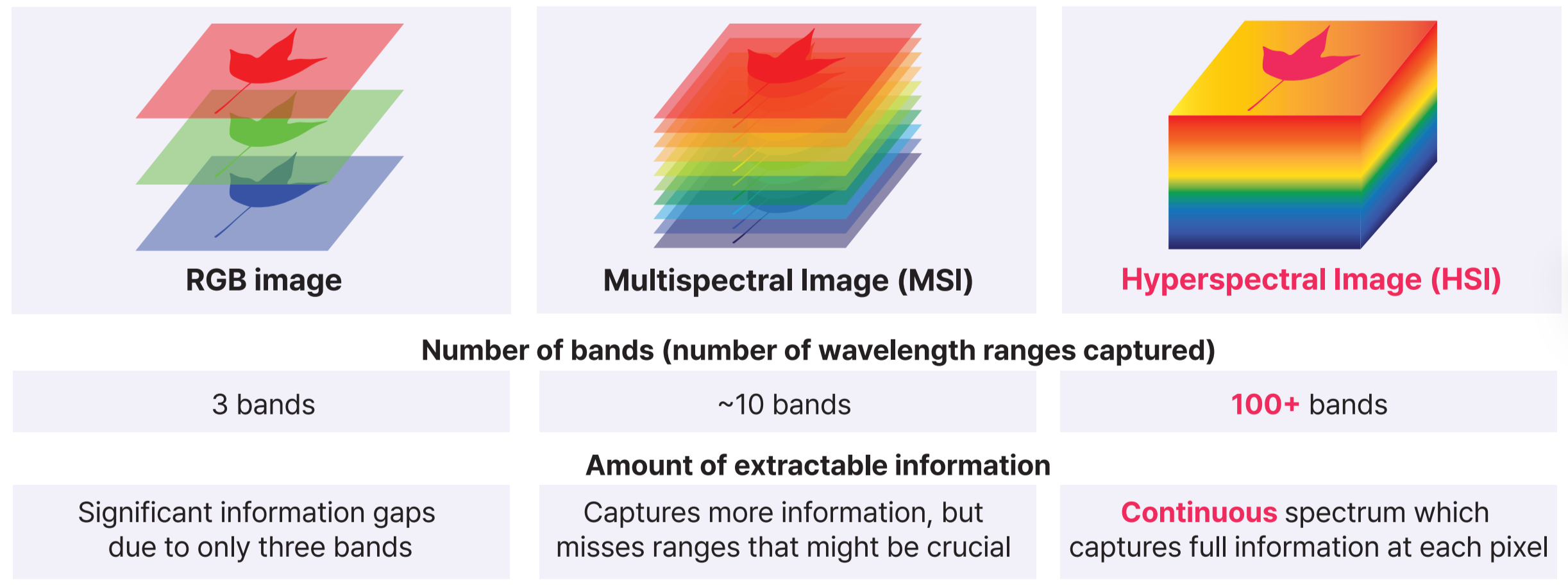
While our eyes only see the world in three broad colors (Red, Green, Blue), HSI breaks light down into hundreds of narrow, continuous bands, revealing hidden details invisible to the naked eye.
The Concept of the Spectral Fingerprint
Just as each person has a unique fingerprint, every material on Earth interacts with light uniquely. Some wavelengths are absorbed, while others are reflected.
By measuring the spectral reflectance across hundreds of wavelengths, HSI creates a unique signature for any object, allowing us to identify materials based on their spectral signatures without physical contact.
Monitors crop health at a chemical level before human eyes can detect issues. HSI can identify specific nutrient deficiencies, water stress, or early disease onset, allowing targeted treatment.
Tracks pollution spills, algal blooms, and atmospheric signals, and measures atmospheric scattering and absorption to monitor air quality and climate change indicators.
Mineral & Resource Exploration
Environmental Monitoring
Precision Agriculture
Real-World Applications
HSI provides continuous spectral data for every pixel, transforming cameras into
powerful chemical sensors.
This technology has moved from satellite-only research into commercial industries, revolutionizing how we monitor our world.
Medical Imaging
-
Monitors crop health at a chemical level before human eyes can detect issues. HSI can identify specific nutrient deficiencies, water stress, or early disease onset, allowing targeted treatment.
-
Airborne HSI systems map large geographic areas to identify specific mineral deposits based on how sunlight reflects off the Earth's surface, heavily used in mining and geology.
-
Enables non-invasive, label-free tissue analysis. Surgeons use HSI to differentiate between healthy tissue and tumor margins in real-time by analyzing oxygenation and cellular signatures.
-
Tracks pollution spills, algae blooms in oceans, and measures atmospheric scattering and absorption to monitor air quality and climate change indicators.
Airborne HSI systems map large areas and help identify mineral deposits based on reflectance patterns, making them valuable in mining and geology.
Enables non-invasive, label-free tissue analysis. Surgeons use HSI to differentiate between healthy tissue and tumor margins in real-time by analyzing oxygenation and cellular signatures.